 Catalogue GéoSAS
25000
Type of resources
Available actions
Topics
Keywords
Contact for the resource
Provided by
Years
Formats
Representation types
Update frequencies
status
Scale
-

Les barrages sont à l’origine de modifications significatives du régime hydrologique, de la température de l’eau et des flux biologiques et biogéochimiques. C’est le cas des barrages de Vezins et de la Roche qui Boit, présents sur le cours principal de la Sélune, et d’autres plus petits obstacles qui fragmentent le bassin versant de la Sélune. Cette couche représente les barrages hydroélectriques de la Sélune, avec les batiments associés, en lien avec la production électrique. La géométrie de ces polygones est issue de plusieurs sources : BD Topo, OpenStreetMap (de 2019), complétée par photointerprétation. Des informations extraites du livre « Quand les rivières reprennent leur cours – Notes sur l’effacement de barrages et de seuils, sur la Sélune et ailleurs » ont été ajoutées pour décrire l'état (en service ou arasé), la nature et les caractérisques physiques de ces barrages.
-
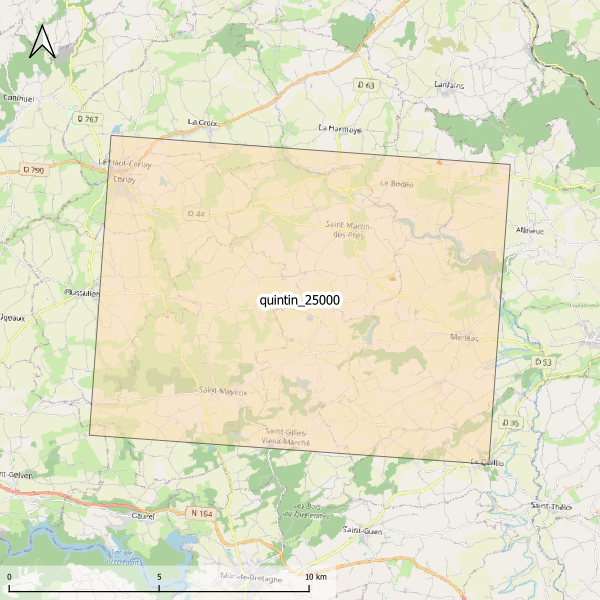
Emprise de la carte pédologique de Quintin au 1/25000. La donnée de base, au format vectoriel, n'est pas publiée.
-
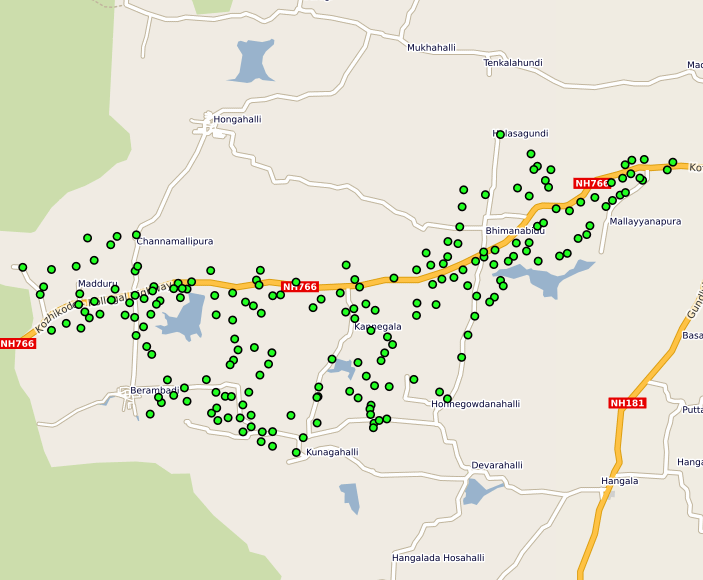
This vector map indicate the Berambadi Monitoring Borewell Locations
-

Dans le cadre du projet Biomonitoring et de l'observatoire Sélune ont été disposées des stations pilotes le long du cours principal de la Sélune, réparties de l’amont à l’aval des barrages hydroélectriques. Trois stations se situent dans les anciennes retenues des barrages, les deux autres, dites de référence, sont hors zone d'influence des anciens barrages (l'une étant en aval et l'autre en amont). Dans ces stations, les biocénoses aquatiques (incluant macroinvertébrés benthiques, biofilms, macrophytes...) sont suivies. 2 campagnes d'échantillonnage (printemps et automne) de macroinvertébrés benthiques (mib) sont réalisées depuis septembre 2014. Lors de chaque campagne, 2 protocoles d'échantillonnage sont mis en oeuvre : - suivant la norme NF T90-333 qui permet le calcul de l'IBG-DCE et l'I2M2 ("SURBER") - via des substrats artificiels immergés pendant 1 mois ("SUBART"), afin de se focaliser sur la mesure de « l’effet des barrages ». Le protocole est décrit dans : Piscart C., Moreteau, J.C., Beisel J.N. (2006). Monitoring changes in freshwater macroinvertebrate communities along a salinity gradient using artificial substrates. Environmental Monitoring and Assessment 116: 529-542. Cette couche détaille les taxons de macroinvertébrés benthiques et leurs abondances obtenus après analyse (selon la norme NF T90-388). Ces données sont distribuées par campagne et par secteur. Les taxons présentant l’ensemble des critères morphologiques clairement visible et caractéristique permettant l’exactitude de leur détermination et un état de conservation irréprochable sont intégrés à la collection de référence de l’Observatoire Sélune. Celle-ci est consultable sur demande (cf. point de contact). La détermination des taxons s'appuie sur la version v17 de la référence TAXREF. Le jeu de données est actuellement sous embargo.
-
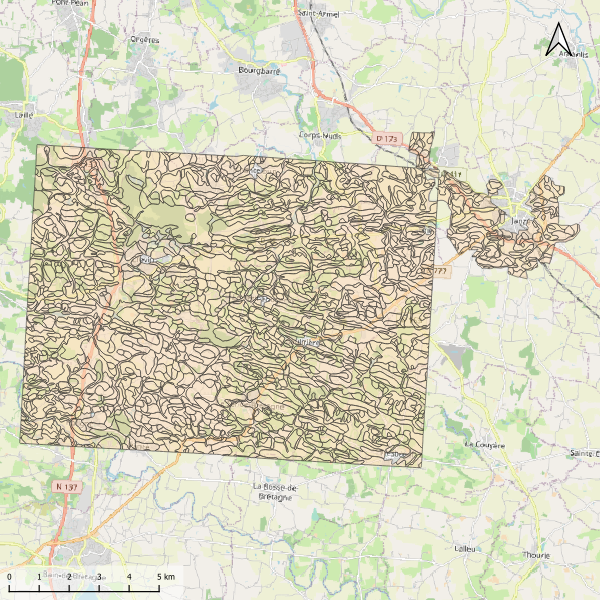
Carte pédologique de Janzé au 1/25000. La codification correspond au code 4 critères des sols du Massif armoricain (voir ressources en ligne). Les champs de la table attributaire sont : - SUB : Matériau(x) parental(ux) à partir du(des)quel(s) se développe le sol - HYD : Classe d'hydromorphie, de 0 (sol bien drainé) à 9 (sol extrêmement hydromorphie) - TYPE : Développement de profil défini à partir de la succession des horizons - PROF : Profondeur du sol, classée de 1 (sols très épais) à 6 (sols superficiels) - CODE4C : code 4 critères issu de la concaténation des champs précédents. Les valeurs prises par les différents champs pour chaque entité sont détaillées dans la méthode 4 critères (voir ressources en ligne). - UTS : Numéro d'Unité Typologique de Sol issue du Référentiel Régional Pédologique de Bretagne.
-
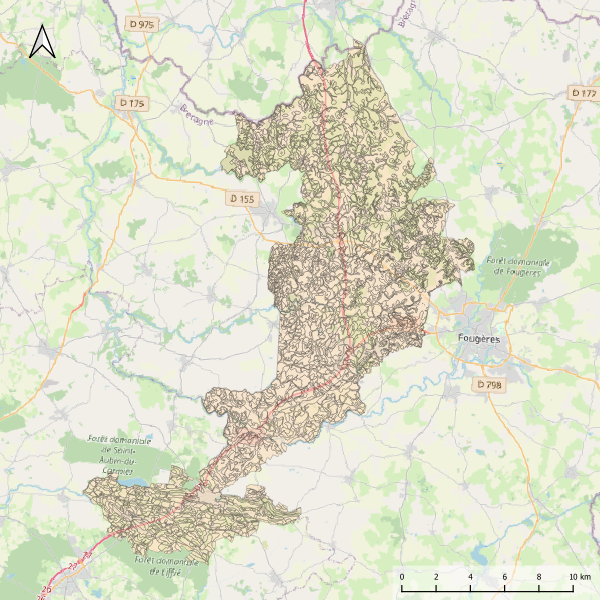
Carte pédologique des estuaires au 1/25000. La codification correspond au code 4 critères des sols du Massif armoricain (voir ressources en ligne). Les champs de la table attributaire sont : - SUB : Matériau(x) parental(ux) à partir du(des)quel(s) se développe le sol - HYD : Classe d'hydromorphie, de 0 (sol bien drainé) à 9 (sol extrêmement hydromorphie) - TYPE : Développement de profil défini à partir de la succession des horizons - PROF : Profondeur du sol, classée de 1 (sols très épais) à 6 (sols superficiels) - CODE4C : code 4 critères issu de la concaténation des champs précédents. Les valeurs prises par les différents champs pour chaque entité sont détaillées dans la méthode 4 critères (voir ressources en ligne). - UTS : Numéro d'Unité Typologique de Sol issue du Référentiel Régional Pédologique de Bretagne. Les numéros des UTS ne sont pas renseignés.
-
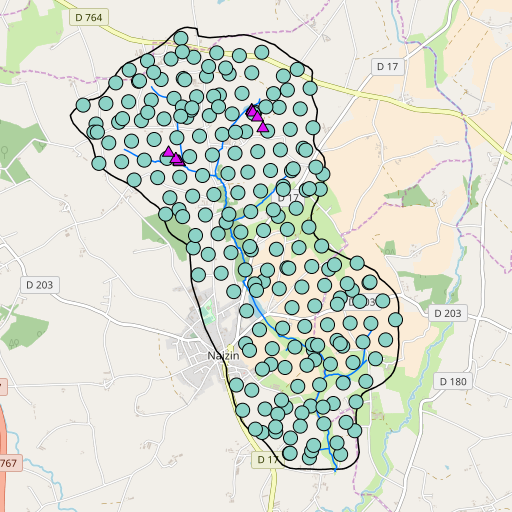
Point de Mesure de l'ANR Mosaic. Le projet Mosaic (2013-2017) est interdisciplinaire et combine différentes approches de la dynamique de la MOS : des techniques avancées de caractérisation chimique et microbiologique de la MO, des approches d'écologie du paysage et d'agronomie systémique. Ce programme s'appuie à la fois sur des observations, des expérimentations et la modélisation.
-
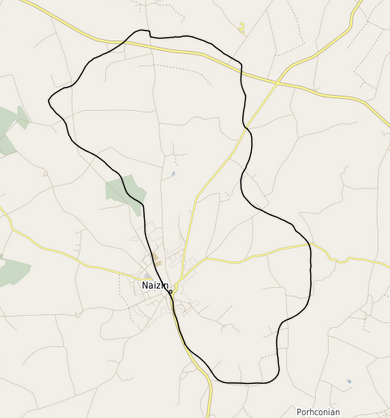
Représentation des contours du bassin versant de la zone d'étude INRA de Naizin. Ces contours correspondent au bassin versant de 12km2 du cours d'eau du Coetdan, le sous bassin sur lequel les observations hydrochimiques sont concentrées depuis 1993 se situe dans les 5km2 amont.
-
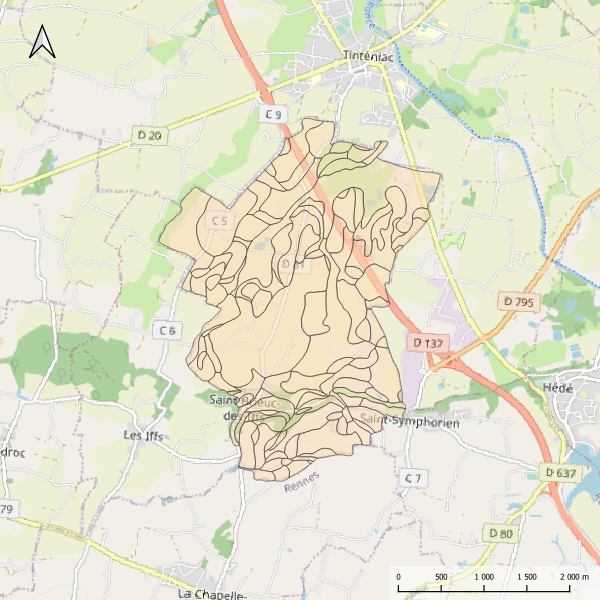
Carte pédologique de Saint-Brieuc-des-Iffs au 1/25000. La codification correspond au code 4 critères des sols du Massif armoricain (voir ressources en ligne). Les champs de la table attributaire sont : - SUB : Matériau(x) parental(ux) à partir du(des)quel(s) se développe le sol - HYD : Classe d'hydromorphie, de 0 (sol bien drainé) à 9 (sol extrêmement hydromorphie) - TYPE : Développement de profil défini à partir de la succession des horizons - PROF : Profondeur du sol, classée de 1 (sols très épais) à 6 (sols superficiels) - CODE4C : code 4 critères issu de la concaténation des champs précédents. Les valeurs prises par les différents champs pour chaque entité sont détaillées dans la méthode 4 critères (voir ressources en ligne). - UTS : Numéro d'Unité Typologique de Sol issue du Référentiel Régional Pédologique de Bretagne. Les numéros des UTS ne sont pas renseignés.
-

Les macrophytes sont un ensemble de plantes aquatiques. Elles se situent à la base de la chaine alimentaire et peuvent fournir un habitat à de nombreuses autres espèces. L’abondance relative des différentes espèces permet de calculer un indice de qualité du milieu (IBMR). Dans le cadre de l'observatoire Sélune ont été disposées des stations pilotes le long du cours principal de la Sélune, réparties de l’amont à l’aval des barrages hydroélectriques. Trois stations se situent dans les anciennes retenues des barrages, les deux autres, dites de référence, sont hors zone d'influence des anciens barrages (l'une étant en aval et l'autre en amont). Dans ces stations, les biocénoses aquatiques (incluant macroinvertébrés benthiques, biofilms, macrophytes...) sont suivies. Les paramètres suivis sont la composition spécifique et le recouvrement, sur 8 stations du cours principal situées à l’amont, à l’aval et sur les zones néo-lotiques des communautés de macrophytes. La fréquence du suivi consiste en une campagne annuelle pour les stations hors retenues (S0, S1 et S5) et deux campagnes annuelles (printemps/automne) pour les stations néo-lotiques (S2, S3.4, S4.1 et S6). Le protocole mis en œuvre est le protocole d’échantillonnage des macrophytes et bryophytes suivant la norme NF T90-395 (octobre 2003) qui définit l’IBMR. Les taxa sont prélevés pour être identifiés en laboratoire. Cette couche donne la valeur de l'indice IBMR et EQR (normé) à une station pour une campagne ainsi que les informations concernant la robustesse de cet indice, les quantités de taxons utilisés pour le calcul de ces indices mais également des informations en terme de proportion de grands groupes floristiques (heterotrophes, algues, bryophytes, pteridophytes, helophytes, phanerogrames, végétation flottante et végétation immergée).