 Catalogue GéoSAS
Environnement
Type of resources
Available actions
Topics
Keywords
Contact for the resource
Provided by
Years
Formats
Representation types
Update frequencies
status
Service types
Scale
Resolution
-

Les barrages sont à l’origine de modifications significatives du régime hydrologique, de la température de l’eau et des flux biologiques et biogéochimiques. C’est le cas des barrages de Vezins et de la Roche qui Boit, présents sur le cours principal de la Sélune, et d’autres plus petits obstacles qui fragmentent le bassin versant de la Sélune. Cette couche représente les barrages hydroélectriques de la Sélune, avec les batiments associés, en lien avec la production électrique. La géométrie de ces polygones est issue de plusieurs sources : BD Topo, OpenStreetMap (de 2019), complétée par photointerprétation. Des informations extraites du livre « Quand les rivières reprennent leur cours – Notes sur l’effacement de barrages et de seuils, sur la Sélune et ailleurs » ont été ajoutées pour décrire l'état (en service ou arasé), la nature et les caractérisques physiques de ces barrages.
-

Le cours amont de la Sélune n'est pas accessible aux poissons migrateurs du fait des deux barrages hydroélectriques. Les lamproies sont bloquées à une quinzaine de kilomètres de la mer par le premier barrage infranchissable de la Roche qui boit. La méthode utilisée pour échantillonner les lamproies est celle mise au point par Lasne et al. (2010) permettant de prélever plus efficacement les individus de très petite taille que par pêche électrique. La méthode s’appuie sur l’utilisation d’un outil dérivé du filet de Surber, permettant de prélever les ammocètes de façon standardisée. Cette enceinte permet de réaliser des prélèvements ponctuels, à la manière des EPA. La réalisation d’un point de prélèvement se déroule en plusieurs étapes. Après avoir localisé un microhabitat favorable, une caisse est enfouie dans le substrat jusqu’à une profondeur d’environ 15 cm. L’opérateur prélève alors le substrat et le dépose dans le filet. La colonne d’eau dans la caisse est filtrée et les sédiments dans le filet déposés sur un tamis afin de récupérer toutes les ammocètes. Ces dernières sont mesurées et des prélèvements génétiques sont effectués lorsque leur taille le permet. Un total de 30 prélèvements maximum est effectué par station. Cette donnée comprend les abondances observées lors des échantillonnages de lamproies selon les années d'étude 2013, 2015, 2019 et 2021.
-

Les barrages sont à l’origine de modifications significatives du régime hydrologique, de la température de l’eau et des flux biologiques et biogéochimiques. C’est le cas des barrages de Vezins et de la Roche qui Boit, présents sur le cours principal de la Sélune qui ont eu pour conséquence, l'existence de deux lacs de retenue entre 1919 et 2022 pour La Roche qui Boit et entre 1932 et 2019 pour Vezins. A compter de la fin de la dernière vidange du barrage de La Roche qui Boit, fin 2022, ces deux lacs n'ont donc plus d'existence dans le paysage de la vallée. Cette couche représente les deux lacs de retenues, tel qu'ils étaient référencés en 2017, soit avant le début des travaux de démantèlement des deux barrages hydroélectriques de la Sélune. Parmi les données attibutaires associées à ces deux entités, la longueur est issue d'un calcul réalisé par l'équipe du projet Sélune sur la base du référentiel de points établis sur la totalité du bassin versant (et donc sur la totalité du cours de la Sélune) et leur connaissance des zones d'influences lacs / cours naturel.
-

L’effacement des barrages de la Sélune fait l’objet d’un programme scientifique initié en 2012 dans lequel des paramètres environnementaux sont suivis afin de fournir un réel retour d’expérience sur cette opération de restauration. En 2019 s’est mis en place un observatoire de données, chargé d’assurer la collecte et le traitement de ces paramètres (biotiques et abiotiques). Les données acquises à partir de 2012 et au moins jusqu’en 2027, seront centralisées grâce à un système d’information (SI), appelé SISelune. SISelune vise à aider les scientifiques associés au programme Sélune et à rendre les données accessibles à tous. Cette couche présente la zone d'étude, basée sur les sous-bassins versants hydrographiques pour la partie continentale, et la masse d'eau de transition pour la baie du Mont St-Michel.
-

Le cours amont de la Sélune n'est pas accessible aux poissons migrateurs du fait des deux barrages hydroélectriques. Les lamproies sont bloquées à une quinzaine de kilomètres de la mer par le premier barrage infranchissable de la Roche qui boit. La méthode utilisée pour échantillonner les lamproies est celle mise au point par Lasne et al. (2010) permettant de prélever plus efficacement les individus de très petite taille que par pêche électrique. La méthode s’appuie sur l’utilisation d’un outil dérivé du filet de Surber, permettant de prélever les ammocètes de façon standardisée. Cette enceinte permet de réaliser des prélèvements ponctuels, à la manière des EPA. La réalisation d’un point de prélèvement se déroule en plusieurs étapes. Après avoir localisé un microhabitat favorable, une caisse est enfouie dans le substrat jusqu’à une profondeur d’environ 15 cm. L’opérateur prélève alors le substrat et le dépose dans le filet. La colonne d’eau dans la caisse est filtrée et les sédiments dans le filet déposés sur un tamis afin de récupérer toutes les ammocètes. Ces dernières sont mesurées et des prélèvements génétiques sont effectués lorsque leur taille le permet. Un total de 30 prélèvements maximum est effectué par station. Ce tableau contient les données individuelles sur les lamproies capturées selon les années d'étude 2013, 2015, 2019 et 2021.
-
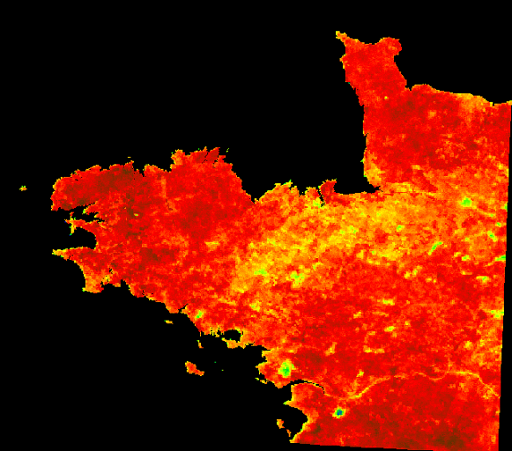
L'Evaporative Fraction (EF) est un indice permettant d'avoir une connaissance relative des zones à fort potentiel hydrique, et inversement, par l'estimation de la capacité d'un sol à évaporer. Cette capacité s'estime via des valeurs allant de 0 (non évaporante) à 1.26 (très évaporante).
-
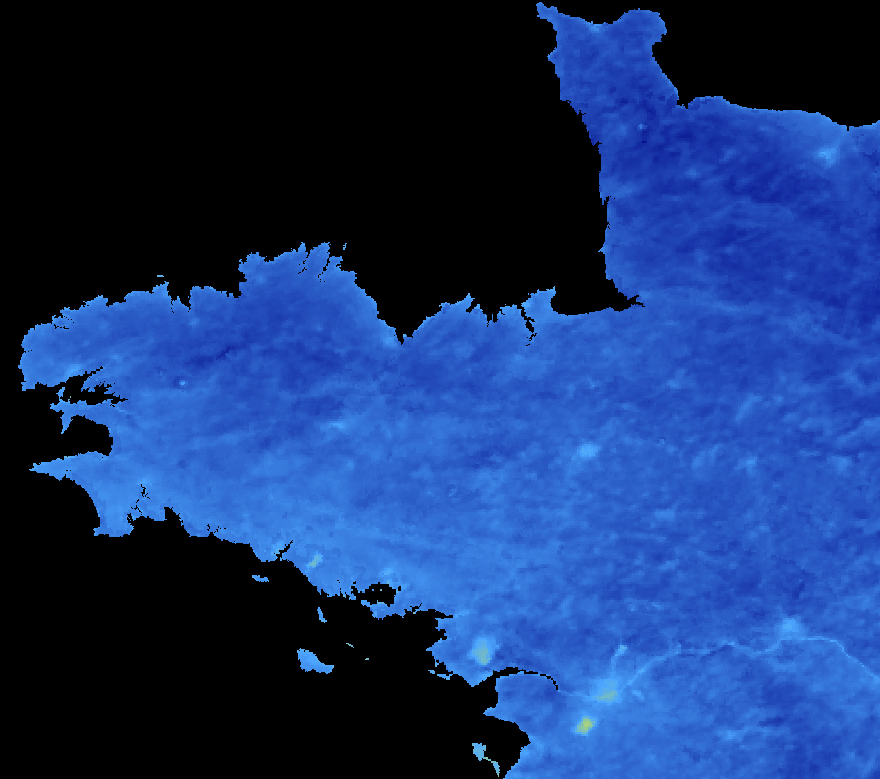
Température moyenne sur 8 jours par ciel clair en Bretagne la nuit. Cette donnée permet de distinguer des lieux où la température est élevée la nuit (eau libre), mais aussi les zones urbaines (îlots de chaleur urbains).
-
Un obstacle à l’écoulement est un ouvrage lié à l’eau qui est à l’origine d’une modification de l’écoulement des eaux de surface (dans les talwegs, lits mineurs et majeurs de cours d'eau et zones de submersion marine). Seuls les obstacles artificiels (provenant de l’activité humaine) sont pris en compte. Les données présentées sont issues de la couche de données ObstEcoul_FXX publiée par le SANDRE restreintes spatialement à l'emprise du bassin versant de la Sélune. Les données récupérées ont été mises à jour le 30/07/2024 à partir du flux mentionné ci-dessus et retraités pour compléter le type de l'obstacle avec un champs "nature" de l'obstacle représentant une aggrégation des types identifiés sur les valeurs suivantes : "Barrage", "Buse", "Digue", "Pont", "Seuil" et "Non renseigné". L'aggrégation mise en place pour renseigner le champ "nature" est la suivante : 1/ récupération des types d'obstacles présents sur le bassin versant (champ de la donnée source "CdTypeOuvr"). 2/ récupération des libellés associés dans la référence SANDRE : https://api.sandre.eaufrance.fr/referentiels/v1/nsa/284.csv?outputSchema=SANDREv3.1 3/ Filtre sur ces libellés pour renseigner le nouveau champ "nature" : - si le libellé contient "barrage" alors "nature" est initialisé à "Barrage" - si le libellé contient "buse" alors "nature" est initialisé à "Buse" - si le libellé contient "digue" alors "nature" est initialisé à "Digue" - si le libellé contient "pont" alors "nature" est initialisé à "Pont" - si le libellé contient "seuil" alors "nature" est initialisé à "Seuil" - si le libellé contient "non renseigné" (initialement code vide) alors "nature" est initialisé à "Non renseigné" Les autres champs proposés le jeu de données sont issus du flux SANDRE original mais renommés. La correspondance est fournie dans le dictionnaire de données associé.
-
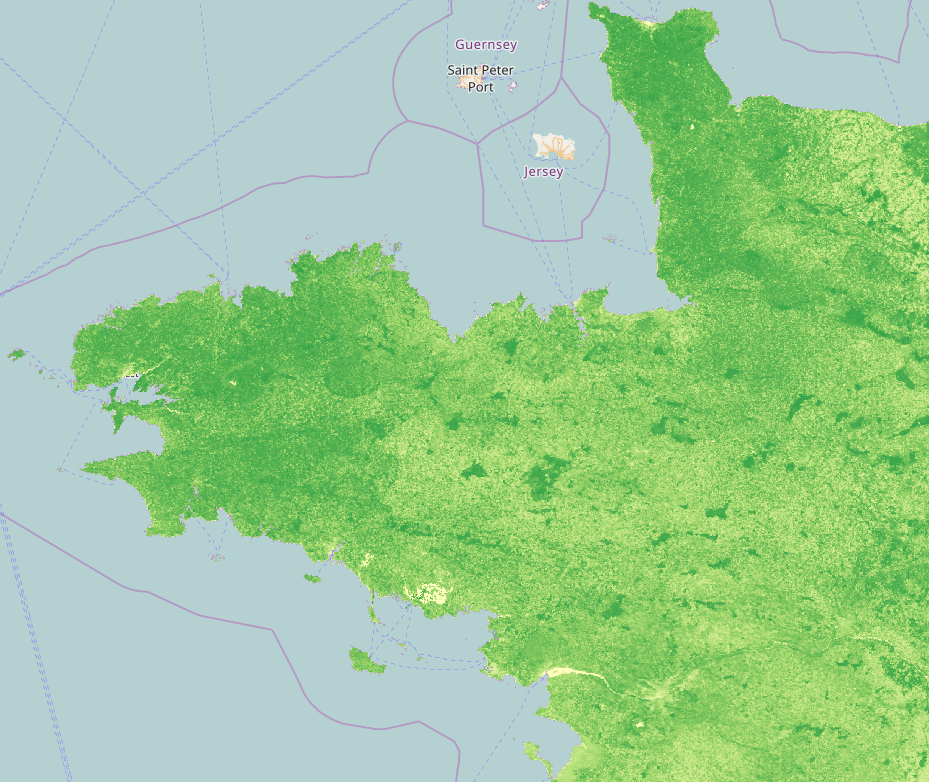
Le Normalized Difference Vegetation Index (NDVI) est un indice de végétation possédant des valeurs entre -1 (surfaces autres que végétation) et 1 (surfaces avec une végétation dynamique). L'aspect temporel de cette donnée permet d'effectuer un suivi phénologique. De cette manière, en plus de distinguer des occupations du sol (cultures, forêts, sols, eau libre), il est possible de distinguer certains usages du sol (maïs, blé).
-
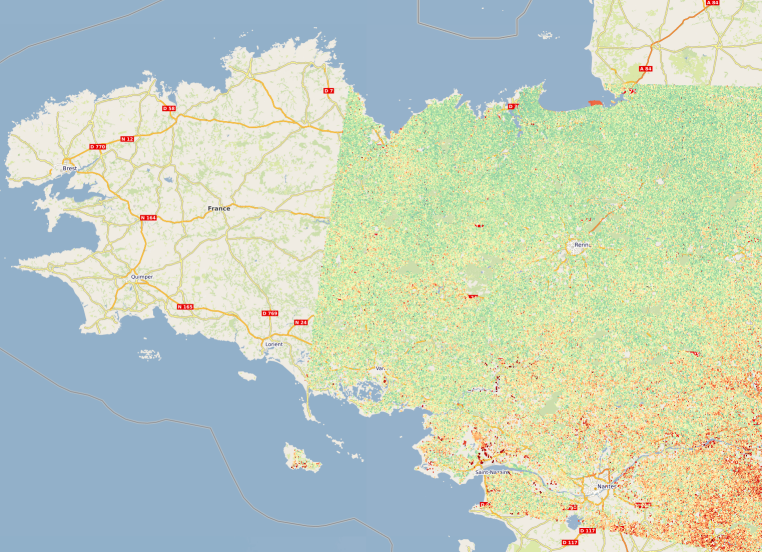
Estimation de l'humidité des sols de Bretagne représentée sous la forme d'une série temporelle d'images raster à 10 mètres de résolution entre janvier 2017 et décembre 2022. La méthode d’estimation de l’humidité, développée à l’INRAE (UMR TETIS), est basée sur l'utilisation d'images satellitaires des nouveaux systèmes d’observation de la Terre Copernicus radar et optique Sentinel-1 et Sentinel-2. Plus d'informations sur la méthode : https://geosas.fr/metadata/pdf/Livrable_TED_Bosco_Mars2022_Bretagne_INRAE_Baghdadi.pdf